How we work
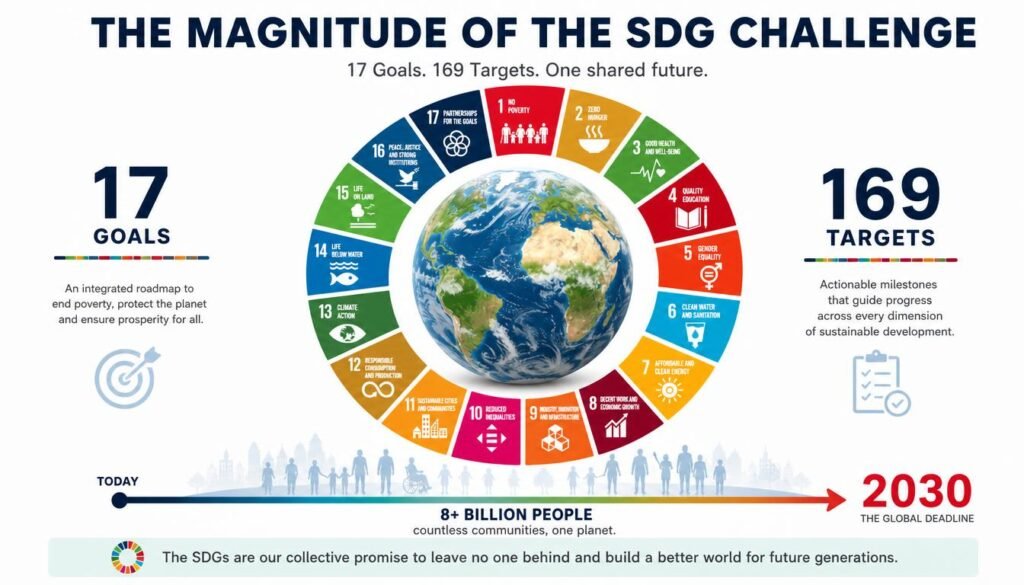
The Sustainable Development Goals (SDGs) were created as a shared global framework to address some of humanity’s most urgent challenges — poverty, inequality, climate change, health, education, food security, and sustainable communities.
Yet a critical gap is emerging:
The world is changing faster than many solutions are adapting.
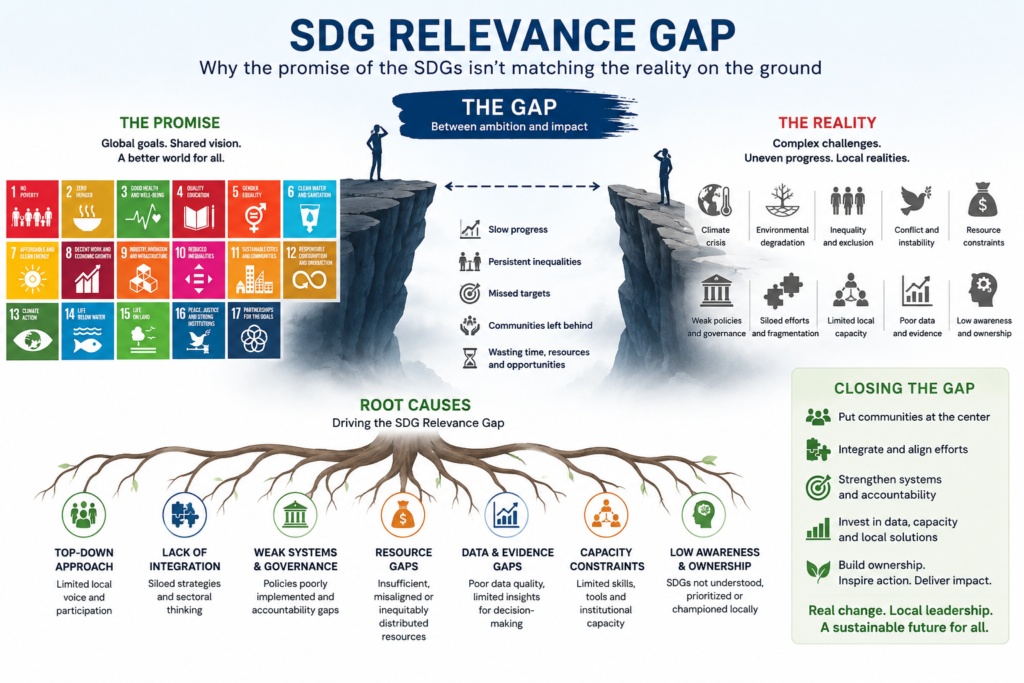
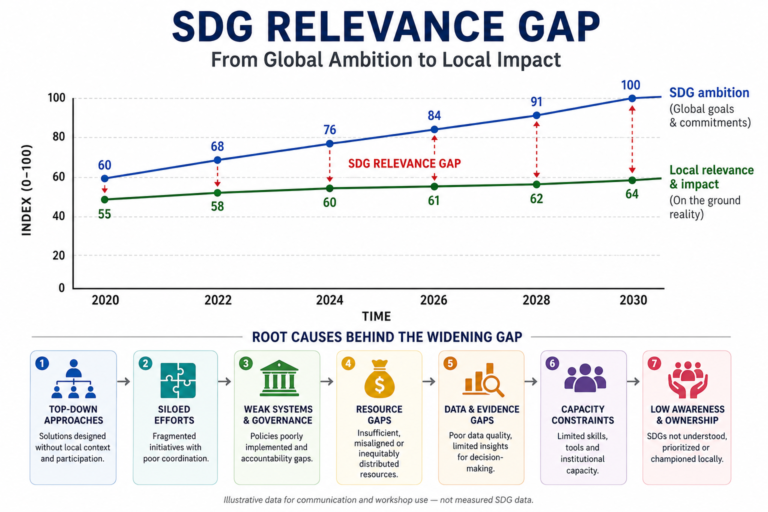
This is the SDG Relevance Gap — the growing distance between the solutions we design and the complex, interconnected problems communities and ecosystems are actually experiencing.
From simple problems to complex systems
Many social-impact interventions are designed around individual problems:
- Improve access to education.
- Increase farmer incomes.
- Provide healthcare.
- Reduce poverty.
- Create employment.
- Protect the environment.
These interventions can create meaningful results. But today’s challenges rarely exist in isolation.
Poverty affects education.
Education affects employment.
Employment affects health and migration.
Climate change affects agriculture.
Agriculture affects food security and livelihoods.
And all of these influence inequality.
The result is a system of interconnected problems where solving one issue without understanding the wider system can produce limited, temporary, or even unintended outcomes.
The gap between activity and impact
Organizations often measure what they do:
Activities → Outputs → Short-term Outcomes
But sustainable SDG progress requires us to ask a deeper question:
Are we changing the system that keeps creating the problem?
For example, training 1,000 farmers is an important activity.
But sustainable impact may depend on much more:
Farmer capability + access to markets + finance + technology + climate resilience + policy + ecosystem partnerships
The difference between delivering an intervention and changing the conditions that sustain a problem is where the SDG Relevance Gap becomes visible.
Why systems change matters
The next generation of social impact cannot rely only on scaling individual interventions.
It requires organizations to understand:
The system → The relationships → The root causes → The leverage points → The pathways to change
This means moving:
From activities → to systems
From isolated solutions → to ecosystem approaches
From short-term outputs → to sustainable outcomes
From treating symptoms → to addressing root causes
From incremental improvement → to transformational impact
Closing the SDG Relevance Gap
Closing the gap requires social entrepreneurs, NGOs, funders, governments, businesses, and communities to rethink how impact is designed.
The question is no longer simply:
“How many people did we reach?”
It is also:
“What changed in the system because of our intervention?”
And ultimately:
“Are we building solutions that remain relevant as the world changes?”
This is the shift from doing more to changing better.
At LEAP X Impact, the focus is on helping social entrepreneurs move from problem-focused interventions toward systems thinking, leverage-point identification, ecosystem building, and sustainable systems change — so that solutions can remain relevant and create deeper, more lasting impact toward the SDGs.